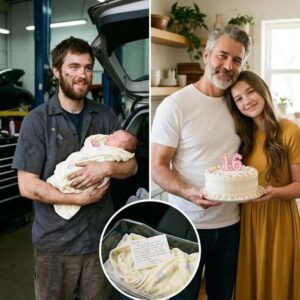
I’ve spent my whole life under the hood of someone else’s car.
Oil under my nails. Grease in the creases of my hands. Twelve-hour shifts in a shop that’s older than half the engines I fix. The coffee machine’s been broken for over a decade, and the front door sticks when it rains.
It’s not glamorous work.
But it keeps the lights on. Barely.
I’m Evan. I’m 36. I’m a mechanic. And I’m raising three six-year-old triplets on my own.
Their mom left when they were eight months old. One suitcase. One sentence — “I can’t do this anymore.” I never saw her again.
My 72-year-old mom moved in after that. She braids my daughter’s hair. She makes real breakfasts when I’m already gone before sunrise. Without her, I don’t think we would’ve made it.
Every day I worry it’s not enough.
That Tuesday started like most bad days do — loud, rushed, and tense. An angry customer got in my face about a repair he hadn’t authorized.
“You should’ve fixed everything!” he barked.
“I can only fix what you approve,” I told him, pointing at the invoice.
He stormed out threatening a review. I stood there wiping my hands, swallowing that familiar sting — the one that says no matter how hard you work, it’s never quite good enough.
Near closing time, I was sweeping under a lift when my broom hit something solid.
A black leather wallet.
I picked it up, expecting loose change and receipts.
Instead, I found thick stacks of $100 bills. More money than I’ve seen in one place in years.
For a second — just a second — I let myself think.
Rent was due. The electric bill was late. My daughter’s shoes had holes in them.
This could fix everything. For a little while.
Then I saw the ID.
Gary. Late 70s. Tired eyes.
And tucked inside the wallet, a folded note with emergency contact info and an address.
My hands started shaking.
I locked it in my toolbox and finished closing up, but my heart wouldn’t settle. That money burned in my thoughts the whole drive home.
After dinner, after bedtime stories, after the house went quiet, I told my mom I had an errand.
I drove to the address.
Small house. Porch light on. TV flickering inside.
I almost turned around. What if he thought I stole it? What if he called the cops?
I knocked.
An older man opened the door, leaning on a cane.
“Can I help you?”
I held up the wallet. “I think this is yours. I found it at my shop.”
His eyes widened. He opened it with shaking hands.
“I thought it was gone,” he whispered. “That’s my pension.”
He pulled out a $100 bill. “Please. Take this.”
I shook my head. “I didn’t return it for a reward.”
“Then why?”
“Because it’s the right thing to do.”
He studied me for a long moment.
“What’s your name, son?”
“Evan.”
He asked about my kids. I told him about the triplets. About my mom. About the dull yellow house near the main road.
I went home feeling lighter.
I had no idea what was coming.
The next morning, pounding on my front door jolted me awake.
7:30 a.m.
I opened it — and froze.
A sheriff stood there.
My first thought wasn’t jail.
It was my kids inside.
“Evan?” he asked.
“Yeah.”
“Can I come in?”
My heart hammered. Had someone accused me of stealing? Had I messed up a repair?
“Did you find a wallet yesterday?” he asked.
“Yes. I returned it.”
He studied my face, then made a call.
“Yeah. It’s him. Bring everything in.”
Three officers walked into my house carrying big boxes.
I stared at them, completely lost.
“Gary is my father,” the sheriff said.
My stomach dropped.
“When I got home from my shift, he told me about you. About how you brought back his pension. How you wouldn’t take a reward. He said you have three six-year-olds.”
The officers started opening the boxes.
Winter coats. Brand-new shoes. School supplies. Groceries. Bags and bags of groceries.
“This is a year’s worth of essentials for your kids,” the sheriff said. “Clothes, school gear, supplies. I added the groceries and gas cards. My dad insisted.”
My mom started crying behind me.
“I can’t accept this,” I said weakly.
“Yes, you can,” he replied. “You could’ve kept that money. No one would’ve known. But you didn’t.”
I sat on my couch after they left, surrounded by boxes, and I cried harder than I have in years.
My daughter came downstairs and pulled out a pink winter coat.
“Is this mine?”
“Yeah, baby,” I managed. “It’s all yours.”
She hugged it like it was treasure.
Later that afternoon, I drove back to Gary’s house.
“I had a feeling you’d come,” he said when he opened the door.
“You didn’t have to do all that,” I told him.
“Yes, I did,” he said gently. “You gave me peace of mind. Let an old man return the favor.”
I shook his hand, and for a moment neither of us said anything.
Sometimes you do the right thing because it’s right. Not because someone’s watching. Not because you expect a reward.
But sometimes — when you least expect it — kindness circles back.
And when it does, it hits you so hard you can’t do anything but stand there with tears in your eyes, realizing you’re not as alone as you thought.